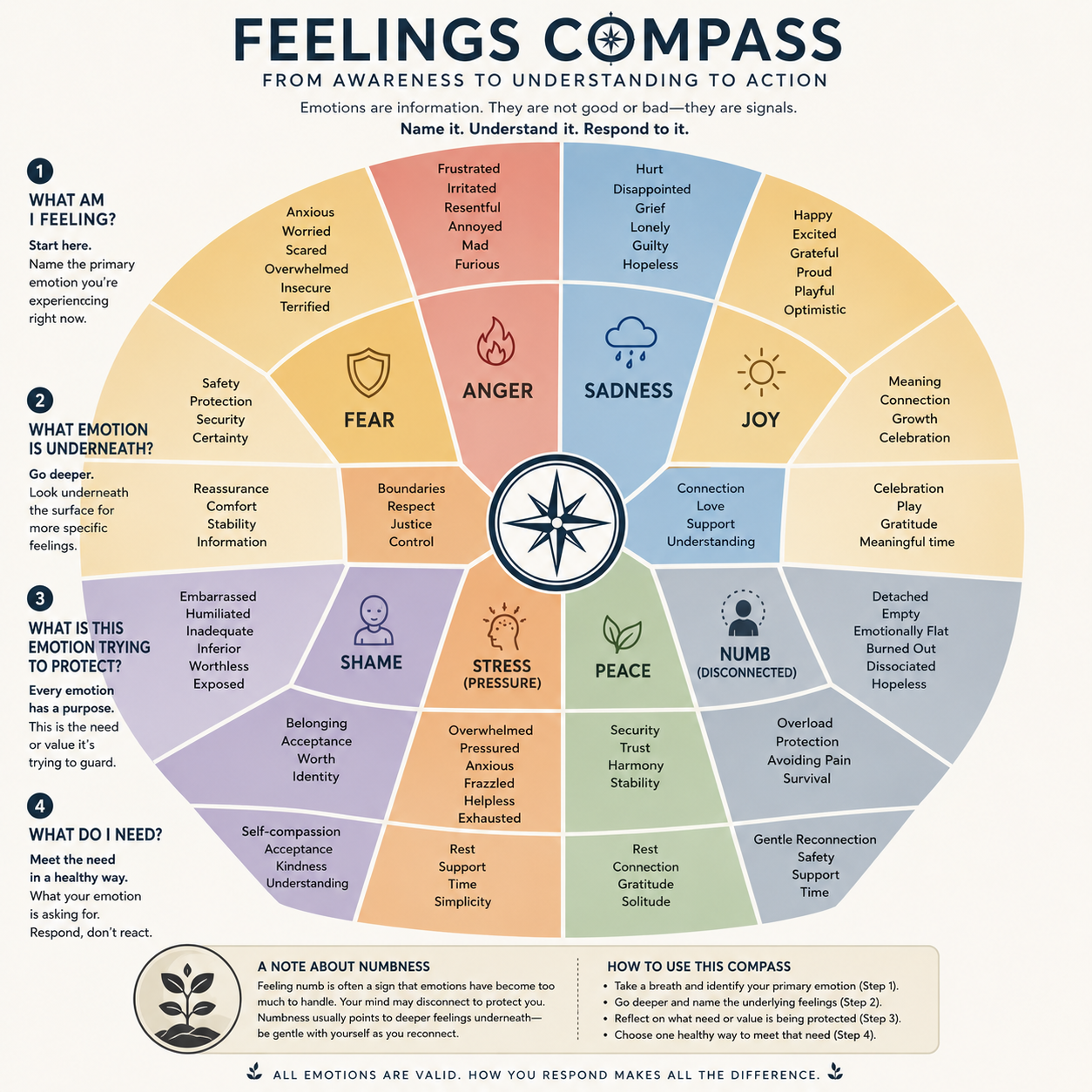
The Feelings Compass
A Practical Tool for Understanding What Your Emotions Are Trying to Tell You
You can't change what you can't name.
Most people believe emotions simply happen to them. They feel anxious, angry, sad, or overwhelmed and assume the emotion itself is the problem. In reality, emotions are not the enemy—they are information. Every emotion carries a message about what is happening inside of you and what may need your attention.
The Feelings Compass was designed to help you move beyond simply identifying how you feel. It helps you understand why you feel that way, what your emotion may be protecting, and how to respond in a healthy, intentional way.
Rather than reacting impulsively, the compass helps you respond thoughtfully.
Why Most People Struggle to Identify Their Feelings
Ask most adults how they're feeling and you'll hear one of four answers:
Fine
Stressed
Angry
Tired
Yet psychologists estimate that humans experience hundreds of distinct emotional experiences. The problem isn't that we don't have emotions—it's that many of us were never taught the emotional vocabulary to describe them.
Children are often taught to identify colors before emotions.
As adults, this limited emotional language makes it difficult to communicate with partners, parents, children, coworkers, and even ourselves.
Research in affective neuroscience has found that putting feelings into words—known as affect labeling—can reduce activity in the amygdala, the brain's threat detection center, while increasing activity in areas of the prefrontal cortex responsible for reasoning and emotional regulation (Lieberman et al., 2007). In other words, simply naming an emotion can help calm your nervous system.
Emotions Are Messengers, Not Managers
One of the biggest mistakes people make is believing every emotion should determine their behavior.
Feelings are important.
They are not always accurate.
Emotions are designed to inform you, not control you. They function like the dashboard lights in your car—they signal that something deserves your attention, but they are not meant to steer the vehicle. Fear may alert you to a potential threat, anger may indicate that a boundary has been crossed, sadness may remind you that you've experienced a meaningful loss, and guilt may encourage you to repair a relationship or realign with your values. Every emotion carries information about your internal experience, making emotions valuable sources of insight rather than problems to eliminate.
The difficulty arises when emotions stop being messengers and start becoming managers. When we allow our emotions to dictate every decision, we often react impulsively instead of responding thoughtfully. For example, feeling anxious does not necessarily mean you are in danger, just as feeling rejected does not necessarily mean someone no longer values you. Emotions reflect your perception of a situation, not always the objective reality. If every emotional impulse becomes an action, fear can become avoidance, anger can become aggression, shame can become isolation, and sadness can become hopelessness.
Emotional maturity is not the absence of strong emotions—it is the ability to pause long enough to listen to what those emotions are communicating before deciding how to act. This process activates the brain's prefrontal cortex, the area responsible for reasoning, judgment, and self-control, allowing it to work alongside the emotional centers of the brain rather than being overwhelmed by them (Siegel, 2020). In other words, healthy emotional regulation doesn't silence your emotions; it places them in their proper role. Your feelings deserve a seat at the table, but they should not be the ones making every decision.
When you begin viewing emotions as guides instead of commanders, your relationship with them changes. Instead of asking, "How do I make this feeling go away?" you begin asking, "What is this feeling trying to tell me?" That simple shift transforms emotions from obstacles into opportunities for growth. They become invitations to examine your needs, values, boundaries, and relationships rather than automatic instructions to react. The goal isn't to ignore your emotions or blindly obey them—it is to listen carefully, think clearly, and choose responses that reflect your values rather than your impulses.
Reflection Questions
Use these questions during moments of stress or emotional discomfort:
What emotion am I experiencing right now?
What evidence supports this feeling?
What might be underneath it?
What need is this emotion pointing toward?
What response would my healthiest self-choose?
There are no "wrong" emotions. The goal is not to judge what you feel but to understand what your emotions are communicating.
Final Thoughts
The healthiest people are not those who never experience difficult emotions. They are the people who have learned to recognize emotions as signals rather than enemies.
The Feelings Compass is not about eliminating sadness, fear, anger, or shame. It is about building emotional awareness so that your feelings inform your decisions instead of controlling them. Every emotion offers an opportunity to learn something about yourself—your values, your needs, your relationships, or your boundaries.
With practice, you'll spend less time asking, "Why do I feel this way?" and more time asking, "What is this emotion trying to teach me?" That shift—from judgment to curiosity—is where meaningful emotional growth begins.
Whether you're navigating anxiety, relationship conflict, grief, trauma, or everyday stress, the ability to identify, understand, and respond to your emotions is one of the most important skills you can develop. Like any skill, emotional awareness improves with practice. Each time you pause, name your feelings, and respond with intention, you strengthen your ability to regulate emotions, communicate more effectively, and make choices that align with the person you want to become.
References
Barrett, L. F. (2017). How Emotions Are Made: The Secret Life of the Brain. Houghton Mifflin Harcourt.
Ekman, P. (2003). Emotions Revealed. Times Books.
Greenberg, L. S. (2015). Emotion-Focused Therapy: Coaching Clients to Work Through Their Feelings (2nd ed.). American Psychological Association.
Lieberman, M. D., Eisenberger, N. I., Crockett, M. J., Tom, S. M., Pfeifer, J. H., & Way, B. M. (2007). Putting feelings into words: Affect labeling disrupts amygdala activity in response to affective stimuli. Psychological Science, 18(5), 421–428.
Siegel, D. J. (2020). The Developing Mind (3rd ed.). Guilford Press.
Van der Kolk, B. A. (2014). The Body Keeps the Score. Viking.
Gross, J. J. (2015). Emotion regulation: Current status and future prospects. Psychological Inquiry, 26(1), 1–26.