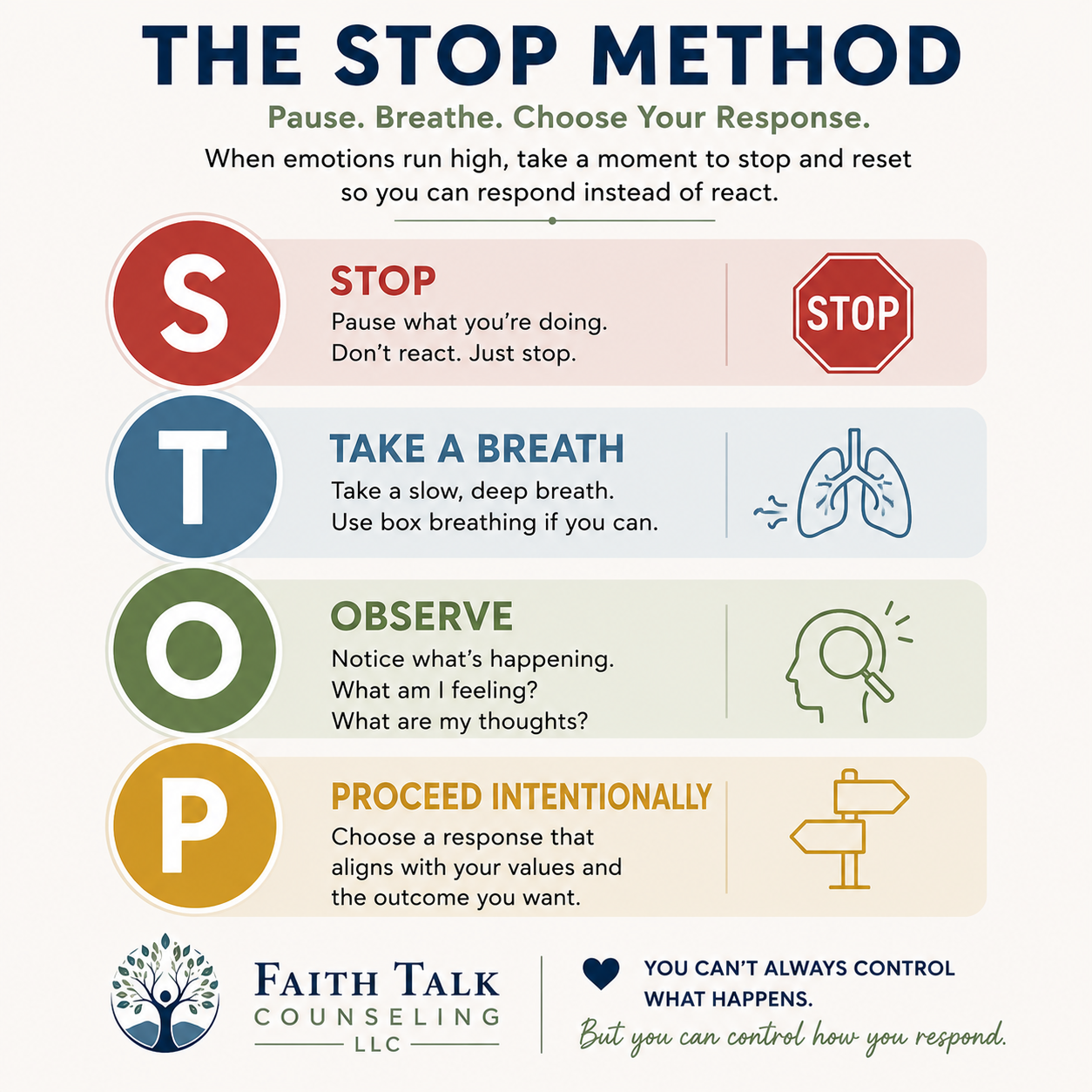
The STOP Method
Pause Before Your Emotions Make the Decision
Have you ever said something in anger that you later regretted? Sent a text too quickly? Made a decision while overwhelmed, only to wish you had slowed down? These moments happen because strong emotions can temporarily take over the brain's ability to think clearly. The STOP Method is a simple coping skill that creates a pause between what you feel and how you respond. That pause is often the difference between reacting impulsively and responding intentionally.
When we become emotionally overwhelmed, the brain shifts into survival mode. The amygdala, the brain's alarm system, becomes highly active, while the prefrontal cortex—the part of the brain responsible for judgment, problem-solving, and self-control—becomes less effective. Psychologists sometimes refer to this as an "amygdala hijack," where emotions temporarily overpower logical thinking (Goleman, 1995; Siegel, 2020). The STOP Method helps interrupt this automatic reaction by giving your brain time to regulate your emotions before making a decision.
How the STOP Method Works
S — Stop
When emotions begin to rise, the first step is simply to pause.
Don't argue.
Don't send the text.
Don't make the decision.
Just stop.
Even a brief pause can prevent your emotions from making a decision you'll later regret.
T — Take a Breath
Take one slow, deep breath—or even better, use Box Breathing.
Slowing your breathing signals your nervous system that you are safe. As your body begins to calm, your heart rate slows, muscle tension decreases, and the thinking part of your brain becomes more active again (Jerath et al., 2015). You cannot always control your emotions, but you can influence them by calming your body first.
O — Observe
Now become curious instead of reactive.
Ask yourself:
What happened?
What emotion am I feeling?
What thoughts are running through my mind?
Am I reacting to the facts or to the story I'm telling myself?
What does this emotion need right now?
Observation creates awareness. Awareness creates choice.
P — Proceed Intentionally
Finally, choose your response instead of allowing your emotions to choose it for you.
Ask yourself:
What response reflects the person I want to be?
Will this help or hurt the situation?
How will I feel about this decision tomorrow?
Responding intentionally doesn't mean ignoring your emotions. It means allowing your values—not your impulses—to guide your behavior.
Why the STOP Method Works
The STOP Method works because it interrupts what psychologists call automatic emotional responding. Our brains are designed to react quickly when they perceive danger, but not every stressful situation is an emergency. By slowing down, calming the body, and observing what's happening internally, you give your brain an opportunity to process the situation more accurately.
Research has shown that simply pausing to identify and label emotions can reduce activity in the brain's threat center while increasing activity in areas responsible for reasoning and emotional regulation (Lieberman et al., 2007). In other words, taking a moment to notice your thoughts and feelings literally helps your brain regain control.
When to Use the STOP Method
The STOP Method can be helpful anytime you notice your emotions beginning to take over, including:
During an argument with your partner
Before sending an emotional text or email
When anxiety starts to spiral
Before making an important decision
When you feel overwhelmed at work
During parenting challenges
After receiving upsetting news
Anytime you notice yourself reacting instead of responding
The more you practice this skill during everyday situations, the easier it becomes to use during life's biggest challenges.
Final Thoughts
The goal of the STOP Method isn't to eliminate difficult emotions. Anger, fear, sadness, and frustration are all normal parts of being human. The goal is to prevent those emotions from making your decisions for you.
Every time you pause instead of react, you strengthen your ability to regulate your emotions, improve your relationships, and make choices that align with your values. Like any skill, emotional regulation improves with practice. The more often you use the STOP Method, the more naturally your brain learns to slow down, think clearly, and respond with intention rather than impulse.
Remember:
You can't always control what you feel, but you can control what you do next.
References
Goleman, D. (1995). Emotional Intelligence. Bantam Books.
Jerath, R., Crawford, M. W., Barnes, V. A., & Harden, K. (2015). Self-regulation of breathing as a primary treatment for anxiety. Applied Psychophysiology and Biofeedback, 40(2), 107–115.
Lieberman, M. D., Eisenberger, N. I., Crockett, M. J., Tom, S. M., Pfeifer, J. H., & Way, B. M. (2007). Putting feelings into words: Affect labeling disrupts amygdala activity in response to affective stimuli. Psychological Science, 18(5), 421–428.
Siegel, D. J. (2020). The Developing Mind (3rd ed.). Guilford Press.