
Healthy Boundaries Without Guilt: How to Protect Your Peace Without Feeling Like the Bad Guy
What Is a Boundary?
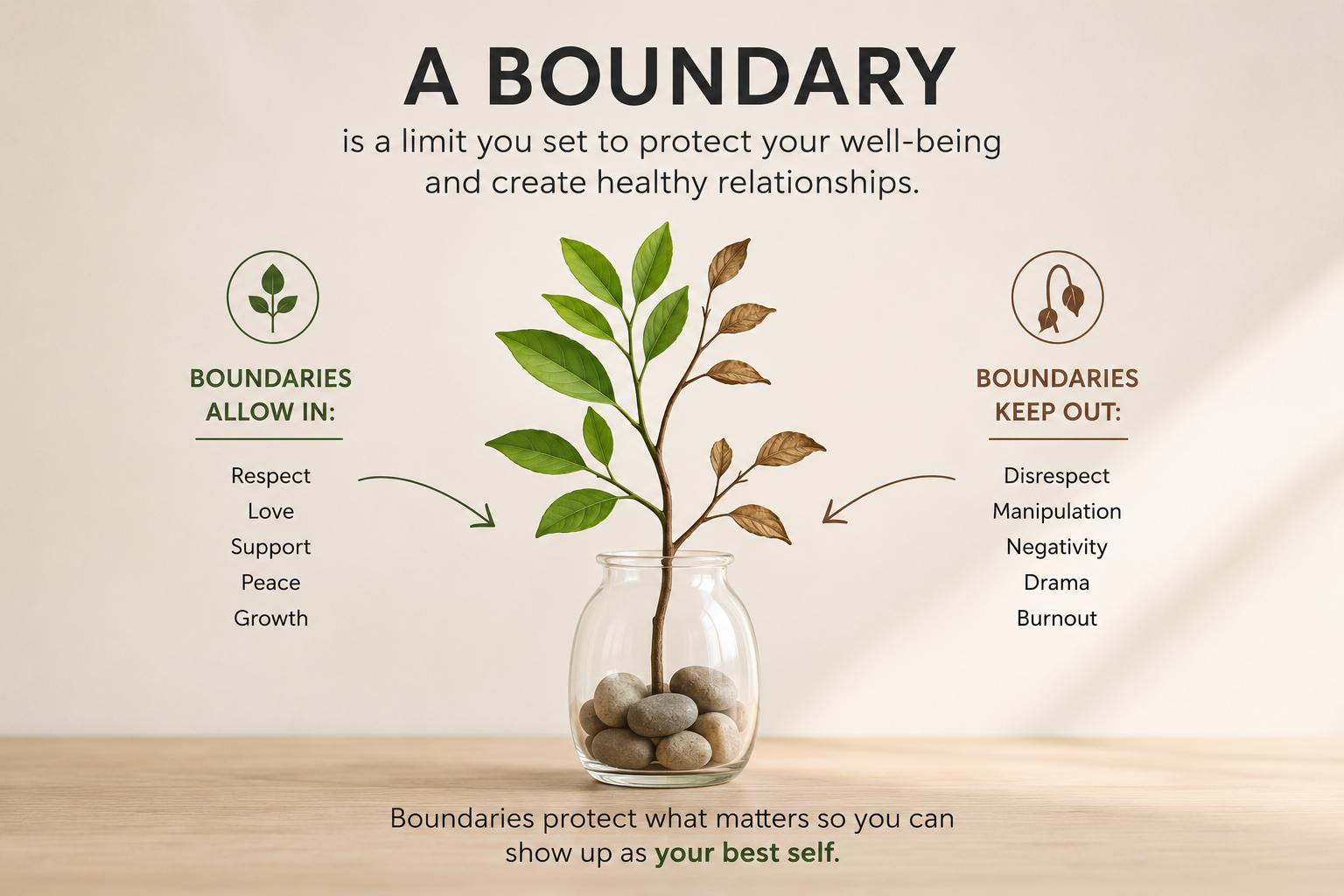
A boundary is a limit you intentionally set to protect your emotional, mental, physical, relational, or spiritual well-being. It defines what you are responsible for and what you are not, allowing you to care for yourself while maintaining healthy relationships with others.
A helpful way to think about it is:
A boundary is not about controlling other people—it is about communicating what you will and will not allow in your own life.
Healthy boundaries answer questions like:
How do I expect to be treated?
What am I willing to do?
What am I not willing to do?
What happens if someone crosses that line?
For example:
Without a boundary: "I'll stay late every day because I don't want anyone to be upset with me."
With a boundary: "I can help today, but I won't be able to stay late regularly."
Or:
Without a boundary: "You can yell at me because I don't want conflict."
With a boundary: "I'm willing to have this conversation, but if yelling continues, I'll end it and we can talk later."
A clinical perspective
Boundaries function much like an immune system. Your immune system doesn't reject everything that enters your body—it distinguishes between what is helpful and what is harmful. Healthy boundaries do the same. They allow trust, intimacy, love, support, and opportunity to enter while filtering out manipulation, disrespect, chronic criticism, and emotional overextension.
What boundaries are not
Boundaries are not:
Punishment
Control
Rejection
Selfishness
Avoidance
What boundaries are
Boundaries are:
Clarity
Self-respect
Consistency
Responsibility
Protection of your energy and values
One of my favorite definitions is:
A boundary is the distance at which I can love you and myself at the same time.
Healthy boundaries don't keep people out—they make healthy relationships possible because they create safety, trust, and mutual respect.
The Biggest Myth About Boundaries
Here are some of the biggest myths about boundaries—especially ones that challenge common assumptions and work well for counseling content.
1. "Boundaries push people away."
Reality: Healthy boundaries don't push healthy people away—they reveal who respects you. They create safer, more authentic relationships by making expectations clear.
2. "Boundaries are selfish."
Reality: Boundaries are acts of stewardship, not selfishness. Protecting your emotional, physical, and mental health allows you to show up more consistently and compassionately for others.
3. "If someone loves me, I shouldn't need boundaries."
Reality: The closer the relationship, the more important boundaries become. Love without boundaries often turns into resentment, enmeshment, or codependency.
4. "Boundaries are about controlling other people."
Reality: Boundaries don't tell others what they have to do—they communicate what you will do. They define your behavior, not someone else's.
Control: "You can't talk to other women."
Boundary: "If fidelity isn't part of our relationship, I won't remain in it."
5. "Good people always say yes."
Reality: Healthy people know when to say yes and when to say no. Constant availability is often a sign of guilt, fear of rejection, or people-pleasing—not kindness.

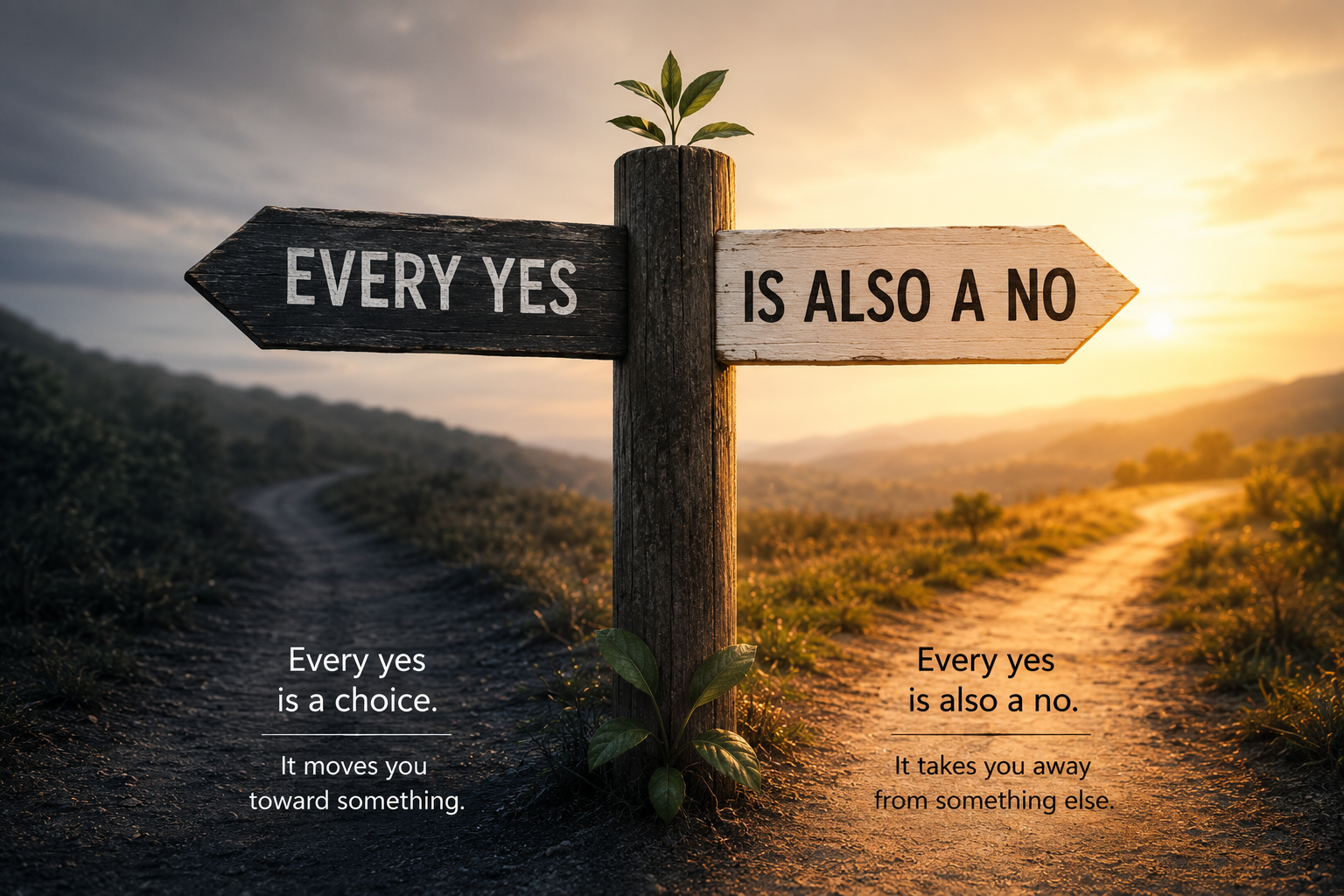
Every "Yes" Is Also a "No"
This statement captures one of the most important principles of healthy boundaries and intentional living:
Every time you say yes to something, you are automatically saying no to something else—even if you don't realize it.
Your time, energy, attention, and emotional capacity are limited. Because they are limited, every commitment has an opportunity cost.
Examples
Saying yes to everyone else's emergencies often means saying no to:
Your own priorities
Your mental health
Your peace
Your recovery
Your goals
Saying yes to scrolling on your phone for two hours means saying no to:
Sleep
Learning something new
Connecting with your spouse
Going for a walk
Finishing a meaningful project
Saying yes to a toxic relationship often means saying no to:
Emotional safety
Self-respect
Healthy relationships
Personal growth
A Different Perspective
Imagine you receive 100 units of energy every morning.
Every commitment costs something:
Work meeting: 15
Helping a friend move: 20
Taking your kids to practice: 15
Worrying about things you can't control: 25
Arguing on social media: 10
By the end of the day, your energy is gone—not because you did anything "wrong," but because every yes spent a portion of a finite resource.
Boundaries help you spend that energy intentionally.
The Real Lesson
The goal isn't to say yes less.
The goal is to say yes better.
Every thoughtful yes becomes an investment in the life you want, while every unnecessary yes quietly takes something from the life you're trying to build.
You don't find time for what matters—you make time by deciding what doesn't.
Final Thoughts
Healthy boundaries are not walls that keep people out—they are guidelines that protect what matters most. They help preserve your emotional energy, strengthen your relationships, and allow you to show up as your healthiest self.
If setting boundaries feels uncomfortable, remember that discomfort is often part of growth. The first few times you say "no," your nervous system may interpret it as risky because it is unfamiliar. That doesn't mean it's wrong. It means you're learning a new way of relating to yourself and others.
You cannot pour endlessly into everyone else without eventually running dry. Boundaries allow you to care for others from a place of fullness rather than exhaustion. They create space for honesty instead of resentment, generosity instead of obligation, and connection instead of burnout.
If you struggle with guilt every time you advocate for yourself, therapy can help you explore where those beliefs began, develop healthier communication skills, and learn how to protect your peace without sacrificing your compassion.
Remember:
You can be kind without saying yes to everything. You can love someone without carrying responsibilities that belong to them. And you can set healthy boundaries without feeling guilty for honoring your own well-being.
References
American Psychological Association. (2023). APA Dictionary of Psychology. https://dictionary.apa.org
Brown, B. (2010). The Gifts of Imperfection. Hazelden Publishing.
Cloud, H., & Townsend, J. (1992). Boundaries: When to Say Yes, How to Say No to Take Control of Your Life. Zondervan. Gilbert, P. (2009). The Compassionate Mind. New Harbinger Publications. LePera, N. (2021). How to Do the Work.
Harper Wave. Neff, K. D. (2011). Self-Compassion: The Proven Power of Being Kind to Yourself.
William Morrow. Siegel, D. J. (2020). The Developing Mind (3rd ed.). Guilford Press. Van der Kolk, B. A. (2014). The Body Keeps the Score.
Viking. Worthington, E. L. (2006). Forgiveness and Reconciliation: Theory and Application. Routledge.